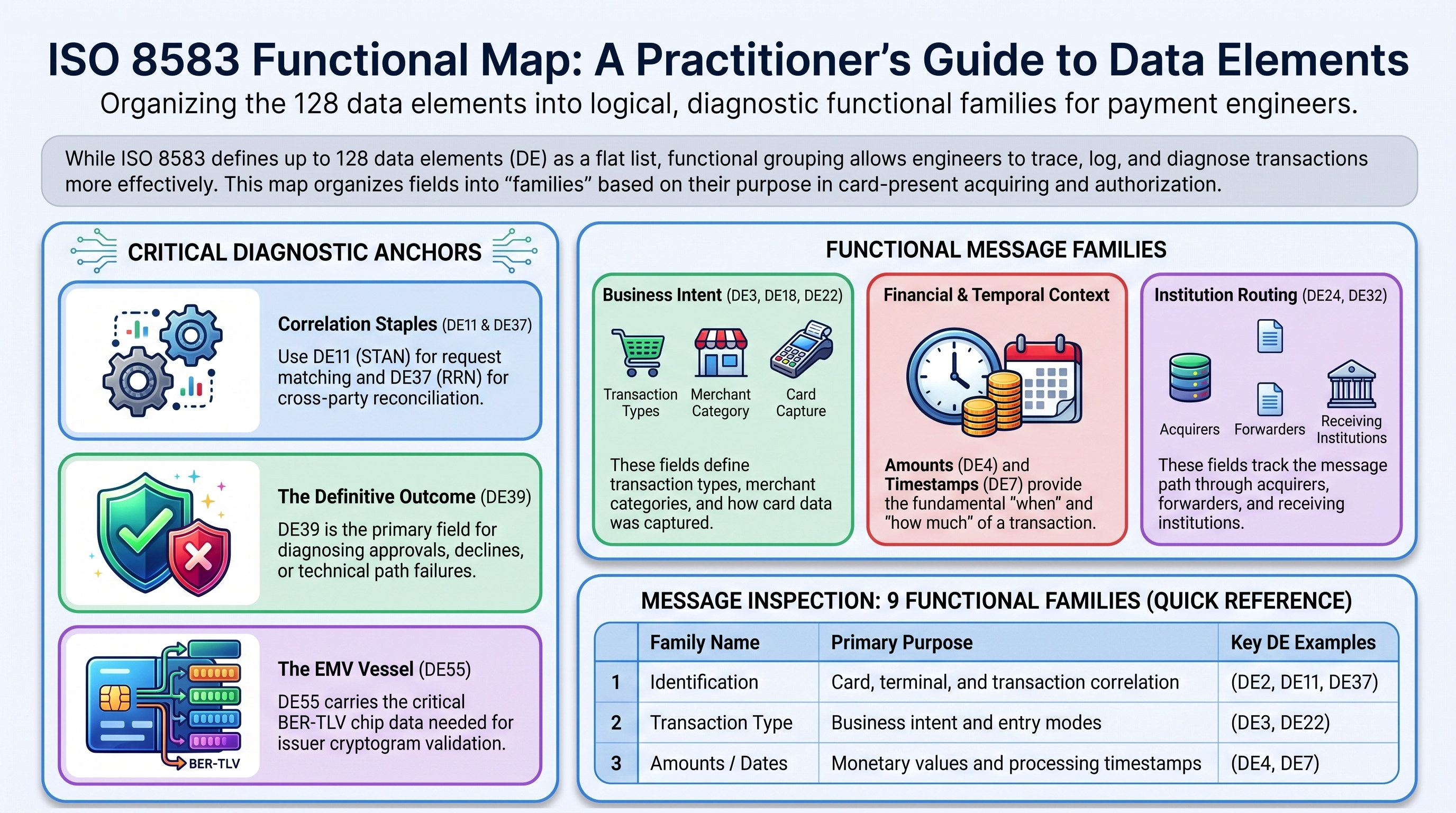
ISO 8583 defines up to 128 data element positions. Treated as a flat numbered list, they are hard to reason about. Grouped by function — the way working engineers already inspect live messages — they become a coherent map for parsers, tracing, logging decisions, and authorization diagnosis.
This post maps that DE space into nine functional families: what each family is for, and which fields you open first in card-present acquiring.
The field groupings below are a practitioner map grounded in POINT OF SALE ARCHITECTURE (the book), Chapter 2 (ISO 8583 context and DE55 carriage) and Chapter 16 (scheme integration: MTI, bitmap, data elements, STAN/RRN correlation, profiling vs the base standard). Exact presence, encoding, and semantics still come from the network or processor profile you are certified against — not from this taxonomy alone.
Claims to keep separate
Confirmed by the standard and common acquiring practice:
- Messages carry data elements only when the corresponding bitmap bit is set; up to 128 positions are defined in the classic primary/secondary bitmap model.
- Identification and outcome fields (notably DE11, DE37, DE39) dominate day-to-day correlation and decline diagnosis.
- DE22, DE24, DE55, and DE60–DE63 are heavily profiled by schemes and processors; the base standard does not fully specify their operational meaning.
- DE55 is the usual vessel for ICC/EMV BER-TLV in card-present online authorizations; the backend typically forwards the blob so the issuer can validate cryptograms (the book, Ch. 2 and Ch. 16).
Interpretation (practitioner grouping, not an ISO chapter structure):
- The “nine families” organization is a diagnostic and design lens. ISO 8583 numbers fields; it does not publish this family table. Fields in the same family share purpose and are almost always inspected together — that is why the map is useful, not because the standard text is laid out that way.
Family 1 — Identification and correlation
These fields identify the card, the transaction instance, and the acceptance infrastructure. They are the first places to look when tracing a transaction across terminal, gateway, switch, and issuer.
| Field | Name |
|---|---|
DE2 | Primary Account Number (PAN) |
DE11 | System Trace Audit Number (STAN) |
DE37 | Retrieval Reference Number (RRN) |
DE41 | Card Acceptor Terminal ID |
DE42 | Card Acceptor Identification Code |
DE43 | Card Acceptor Name/Location |
In practice, DE11 and DE37 are the two you reach for first. DE11 is the short operational trace number generated by the originator, used to match request and response and to support idempotent retries. DE37 is the broader retrieval reference — more useful for cross-party investigations, clearing linkage, and later reconciliation (the book, Ch. 16).
Log DE2 masked or tokenized. Never treat full PAN as an operational correlation key in PCI-scoped logs.
Family 2 — Transaction type and business intent
These fields define what the transaction is and how it should be processed: purchase vs refund vs cash, contactless vs chip vs magnetic stripe, attended vs unattended.
| Field | Name |
|---|---|
DE3 | Processing Code |
DE18 | Merchant Type / MCC |
DE22 | POS Entry Mode |
DE25 | POS Condition Code |
DE22 deserves special attention. It is one of the most profile-sensitive fields in ISO 8583 — sub-structure and coding vary by scheme, acquirer, and version. For SoftPOS and Tap to Pay flows, it is often the field that tells the network how the card data was captured. Getting it wrong can misclassify a contactless transaction, send it down the wrong path, or attach the wrong liability rules.
Family 3 — Amounts, currency, and settlement
These fields carry the monetary values of the transaction.
| Field | Name |
|---|---|
DE4 | Transaction Amount |
DE5 | Settlement Amount |
DE6 | Cardholder Billing Amount |
DE49 | Transaction Currency Code |
DE50 | Settlement Currency Code |
DE51 | Cardholder Billing Currency Code |
Mapping caveat: the 2003 revision reworked amount/currency constructs relative to the 1987/1993 standalone-field style. Many production interfaces still expose DE49–DE51 explicitly. If you map between 1987/1993 profiles and 2003/2023 profiles, treat currency placement as a certification item — do not assume one layout from the edition year alone.
Family 4 — Dates and times
These fields record when the transaction moved through each processing stage.
| Field | Name |
|---|---|
DE7 | Transmission Date/Time |
DE12 | Local Transaction Time |
DE13 | Local Transaction Date |
DE15 | Settlement Date |
DE17 | Capture Date |
For latency investigations, a useful starting trio is DE7 + DE11 + DE37. DE7 gives the transmission timestamp; DE11 and DE37 give correlation handles. Together they support reconstructing timing from terminal through switch to issuer and back — provided clocks and timezone conventions are understood for each hop.
Family 5 — Routing and institution path
These fields describe the institution path through which the message flows.
| Field | Name |
|---|---|
DE19 | Acquiring Country Code |
DE21 | Forwarding Country Code |
DE24 | Function Code / network indicator (edition- and profile-dependent) |
DE32 | Acquiring Institution ID Code |
DE33 | Forwarding Institution ID Code |
DE100 | Receiving Institution ID Code |
DE101 | File Name / institution-dependent usage |
Inspect this family when different products or schemes appear to take different gateways or processing paths. ISO 8583 supplies the framework; routing semantics are network-specific. DE24 in particular is implementation-dependent: older profiles often treated it as a network international identifier; later editions use Function Code; live processors may overload it further. Confirm meaning from the host or scheme guide before drawing routing conclusions.
Family 6 — Card and account details
These fields carry card instance and account information beyond the PAN.
| Field | Name |
|---|---|
DE14 | Expiry Date |
DE23 | Card Sequence Number |
DE35 | Track 2 Data |
DE45 | Track 1 Data |
DE102 | Account Identification 1 |
DE103 | Account Identification 2 |
For EMV implementations, DE23 (Card Sequence Number) commonly maps to EMV tag 5F34. Track data (DE35/DE45) is sensitive; do not log it. For Track 2 structure and where it still appears in modern flows, see Track 2 data.
Family 7 — Authorization result and response handling
These fields carry the outcome of the authorization request.
| Field | Name |
|---|---|
DE38 | Authorization ID Response (Approval Code) |
DE39 | Response Code |
DE44 | Additional Response Data |
DE39 is the definitive outcome field for most debugging: approved, declined, or a technical/path failure as coded by the profile. Later editions support broader response-code spaces than the original two-digit style, which enables finer decline-reason reporting when the network actually uses them. Always interpret DE39 against the profile’s code list — including partial-approval and soft-decline conventions where those exist.
Family 8 — Security and cryptography
These fields carry PIN blocks, message authentication codes, and key-management data.
| Field | Name |
|---|---|
DE52 | PIN Data |
DE53 | Security Related Control Information |
DE64 | Message Authentication Code (Primary) |
DE96 | Key Management Data |
DE128 | Secondary Message Authentication Code |
Never log DE52. In DUKPT-based PIN deployments, DE53 and DE96 commonly carry key-set / control context for the PIN block in DE52 — exact layouts are profile- and HSM-specific and sit under PCI PIN requirements. For the device-to-HSM key path, see DUKPT key derivation and PIN translation.
Family 9 — ICC / EMV and POS extension area
This is where modern card-present implementations place richer terminal and chip data.
| Field | Name |
|---|---|
DE55 | ICC / EMV Data |
DE60 | Network private / POS data |
DE61 | Network private / terminal data |
DE62 | Network private / issuer data |
DE63 | Network private data |
DE123–DE127 | Extended private / network-specific constructs |
DE55 is the primary vessel for ICC/EMV data in most network profiles. It carries BER-TLV from the chip transaction — cryptograms, issuer script results, and terminal verification results among them. The acquirer backend’s usual job is to build or forward that envelope without reshaping tags the issuer needs for ARQC validation (the book, Ch. 16). For cryptogram semantics, see ARQC and company.
DE60–DE63 are network-defined private areas. Their content is processor-specific and must be read against the processor’s specification, not the base standard alone. Engineers who skip that step spend a lot of time misreading valid messages.
Practical field map for card-present acquiring
If you work on card-present acquiring, these are the fields you typically open first:
- Trace and correlate: DE2 (masked), DE11, DE37, DE41, DE42
- Classify the transaction: DE3, DE18, DE22, DE25
- Read the money: DE4, DE49
- Establish timing: DE7, DE12, DE13
- Follow the routing: DE24, DE32, DE33
- Read the outcome: DE38, DE39
- EMV and security: DE52, DE53, DE55, DE64, DE96, DE128
Two families dominate most diagnostic work: identity/correlation (DE11, DE37) and authorization result (DE39). Everything else adds context around those anchors — classification, amounts, path, chip data, and crypto.
For the end-to-end path those fields ride on, see What actually happens in the 2–3 seconds of a card payment.
References
- International Organization for Standardization, ISO 8583:2023 — Financial transaction card originated messages — Interchange message specifications, Geneva, 2023.
- ISO 8583:2003 / ISO 8583:2019 — earlier editions still widely referenced in acquiring interfaces and certification packs (version code
2lineage). - Bevia, V., Point-of-Sale Systems Architecture, Chapter 2 (payment architecture / ISO 8583 context, DE55 carriage) and Chapter 16 (scheme integration: MTI, bitmap, data elements; STAN/RRN; profiling vs base standard): corebaseit.com/my-books.