In a few short years, Large Language Models (LLMs) have moved from research labs into the core of how we work. They are no longer experimental novelties; they shape how we search, draft, and decide. Yet as these systems spread, a collective anxiety has taken root: the fear that AI is “making us dumb” by automating the friction out of thought.
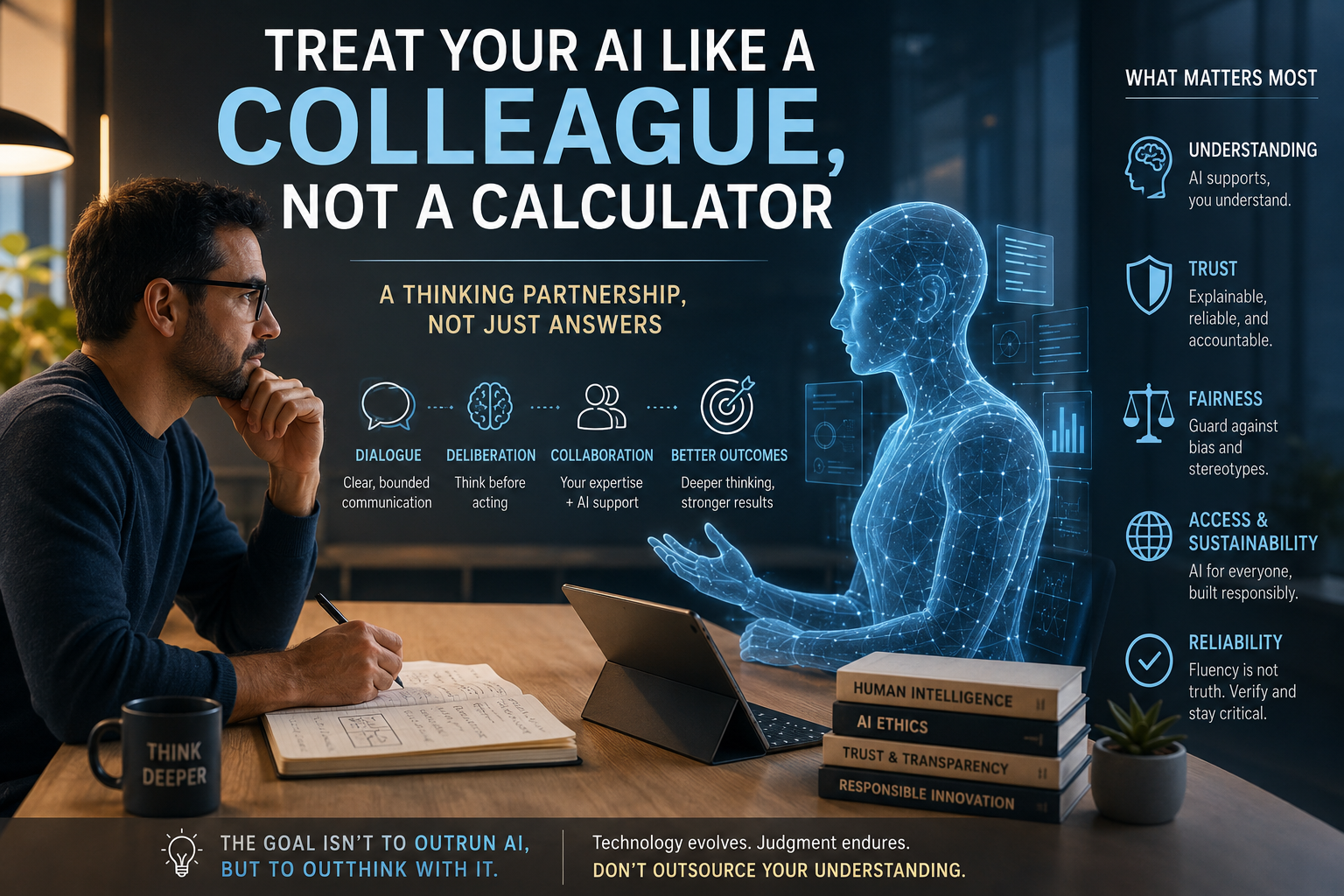
We must reject this fatalism. To stay relevant, we cannot try to outrun the machine in speed; instead, we must outpace it in intent. The divide between support and understanding is where human agency lives. AI can support your thinking, but it cannot replace your understanding. The shift required is psychological: we must move from viewing AI as a calculator for answers to treating it as a colleague for exploration.
The Politeness Protocol: Stop Treating LLMs Like Tools
It may seem paradoxical to apply human social norms to a digital architecture, but treating an AI agent like a person is a practical strategy for avoiding misuse. When we view AI as a mere tool — a hammer or a spreadsheet — we tend to force it into rigid boxes, often applying it to the wrong problems or expecting mechanical perfection.
Adopting a “Politeness Protocol” isn’t about being “nice” to silicon; it is about establishing a framework for clear, bounded communication. By using the same clarity, authenticity, and boundaries you would offer a human colleague, you refine the model’s focus. This includes the “one task at a time” rule. Just as multitasking degrades human performance, it fractures the attention mechanism of a model. Focusing on a single objective avoids the cognitive overload that leads to fragmented, low-quality outputs.
The principle is straightforward: if you treat an AI as a tool, you will mistreat it or use it for the wrong job. If you treat it as a colleague helping you with a task, you will communicate more clearly — and get better results.
The Power of Slow: Why Reasoning Models Are Changing the Game
For years, the AI industry optimized for speed. We are now entering an era where “fast” is no longer the primary benchmark of intelligence. A new class of Reasoning Models is designed to think before acting — spending extra computation working through a problem before committing to a response.
This deliberate approach matters most for high-stakes tasks that require more than pattern matching:
- Mathematics and coding: working through complex logic and syntax without taking shortcuts.
- Debugging and planning: identifying silent errors and mapping multi-step sequences.
- Architectural decisions: weighing structural trade-offs with systemic foresight.
These models demand more memory, higher cost, and greater latency. The trade-off is a measurable gain in output quality. For any task where accuracy matters more than speed, being deliberate is almost always more valuable than being fast.
The Interactive Tutor: Moving Beyond the “Answer Engine”
One of the most underused capabilities of LLMs is their role as interactive tutors. Most people treat them as answer engines — ask a question, copy the output. The real value lies in using the model to sharpen your own thinking. Instead of outsourcing the final product, you use the AI to stress-test your ideas.
By shifting the focus from generation to practice, the AI becomes a mirror that helps you find your own voice faster:
- Refining voice: test different styles and tones to see which resonates most authentically with your intent.
- Clarifying thought: use the model as a sounding board to explain complex concepts simply, ensuring your own grasp of the material.
- Rapid iterative feedback: move through cycles of critique and revision in seconds, using the AI to identify blind spots in your reasoning.
In this partnership, the AI doesn’t do the work for you; it supports the thinking work that allows you to grow.
Next-Word Prediction: The Simple Secret to Emergent Intelligence
The core mechanism of LLMs is a deceptively simple task: predicting the next word. Unlike a human student, an AI is never “taught” a lesson. Instead, it is granted exposure. By processing massive repositories of text, code, and structured data, the model captures the statistical patterns underlying language and knowledge.
This is where emergence comes in. Through the repeated task of prediction, the model moves beyond sentence completion and begins to capture underlying structures — facts, relationships, logical chains. When the model reaches sufficient scale, it stops merely reproducing patterns; it begins to connect disparate ideas and reason across contexts. While it lacks human consciousness, the depth of its training allows it to produce behavior that is, for practical purposes, functionally intelligent.
The Trust Frontier: Black Box Challenges
The evolution of LLMs faces five hurdles that go beyond technical bugs. These are the constraints that will determine whether these systems earn real-world trust:
- Explainability. Many models remain black boxes. To move from curiosity to utility, future systems must provide clear reasoning paths, showing why a conclusion was reached.
- Bias. Inheriting human data means inheriting human stereotypes. Reducing this requires more than filters; it requires rigorous, cross-cultural evaluation to ensure the “thinking partner” isn’t a mirror of our own prejudices.
- Multimodal reasoning. Intelligence confined to text is incomplete. The next generation of models must reason coherently across images, audio, video, and documents.
- Accessibility and sustainability. The immense energy and infrastructure costs of large models threaten to limit AI to well-funded organizations. Lightweight, efficient architectures are a prerequisite for broad adoption.
- Reliability. We must never confuse fluency with truth. Hallucinations — fluent but false answers — remain the primary barrier to adoption. Reliability requires stronger links to external facts and better signals for uncertainty.
The Future Is Measured in Trust
The next phase of AI will be defined by practical human utility, not by model size or benchmark leaps. The question that matters: can this system support real work without creating new risks?
The future depends on our ability to maintain a thinking partnership that preserves our own agency. As we integrate these models into professional and personal work, the core discipline remains the same: do not outsource your own understanding.
References
- D. M. Berry, “Why Large Language Models Appear to Be Intelligent and Creative: Because They Are?”, Computer, IEEE Computer Society, 2025. The article explores why LLMs can appear intelligent and creative, and why reducing them to “just next-word prediction” misses part of what makes their behavior useful in practice.
- S. Amershi, D. Weld, M. Vorvoreanu, A. Fourney, B. Nushi, P. Collisson, J. Suh, S. Iqbal, P. N. Bennett, K. Inkpen, J. Teevan, R. Kiber, and E. Horvitz, “Guidelines for Human-AI Interaction,” Proceedings of the 2019 CHI Conference on Human Factors in Computing Systems, paper no. 3, May 2019, doi: 10.1145/3290605.3300233. A practical framework for designing AI systems with feedback, transparency, user control, and appropriate boundaries.
- J. Wei, X. Wang, D. Schuurmans, M. Bosma, B. Ichter, F. Xia, E. Chi, Q. V. Le, and D. Zhou, “Chain-of-Thought Prompting Elicits Reasoning in Large Language Models,” Advances in Neural Information Processing Systems (NeurIPS), vol. 35, pp. 24824–24837, 2022, arXiv:2201.11903. A foundational paper on why intermediate reasoning steps improve performance on complex tasks.
- National Institute of Standards and Technology, “Artificial Intelligence Risk Management Framework (AI RMF 1.0),” NIST AI 100-1, Jan. 2023, doi: 10.6028/NIST.AI.100-1. A professional reference on trustworthy AI: reliability, explainability, fairness, accountability, and risk management.